
Sidgwick Avenue closes to through traffic from Monday 23 November, with access from Grange Road and Queen's Road only. The bollard trial runs 12 to 18 months.
Updated 17 November: the through route closes from Monday 23 November. Drivers will reach Sidgwick Avenue from Grange Road or from the Silver Street and Queen’s Road junction, but cannot drive from one end to the other. Addresses west of the new bollards are reached from Grange Road, and those east of them from Queen’s Road, the GCP’s November update says. It has not yet given the date the experimental order starts, which opens the feedback period.
Cars will no longer be able to drive the length of Sidgwick Avenue once a trial now being built is finished. Drop-down bollards will stop through traffic in the middle of the street, and the parking bays have gone to make room for a wider pavement.
The Greater Cambridge Partnership (GCP) started work on Monday 19 October. Its announcement says the works will take eight weeks, and the trial will then run for at least a year and up to 18 months.
What is changing
The GCP’s project page lists the measures:
- the northern pavement widened to two metres
- all on-street parking removed, from Sunday 18 October
- drop-down bollards to stop through traffic
- potholes and damaged road surfaces repaired
The bollards go between the drop-off area in front of Newnham College and the service entrance to the Sidgwick Site. That is in the report the GCP Executive Board approved on 5 March. Every driveway and access point on the street stays reachable by car. Only the through route is closed.
Emergency vehicles can still get through. The bollards have “Fire Brigade” locks, the report says.
Why the GCP is doing it
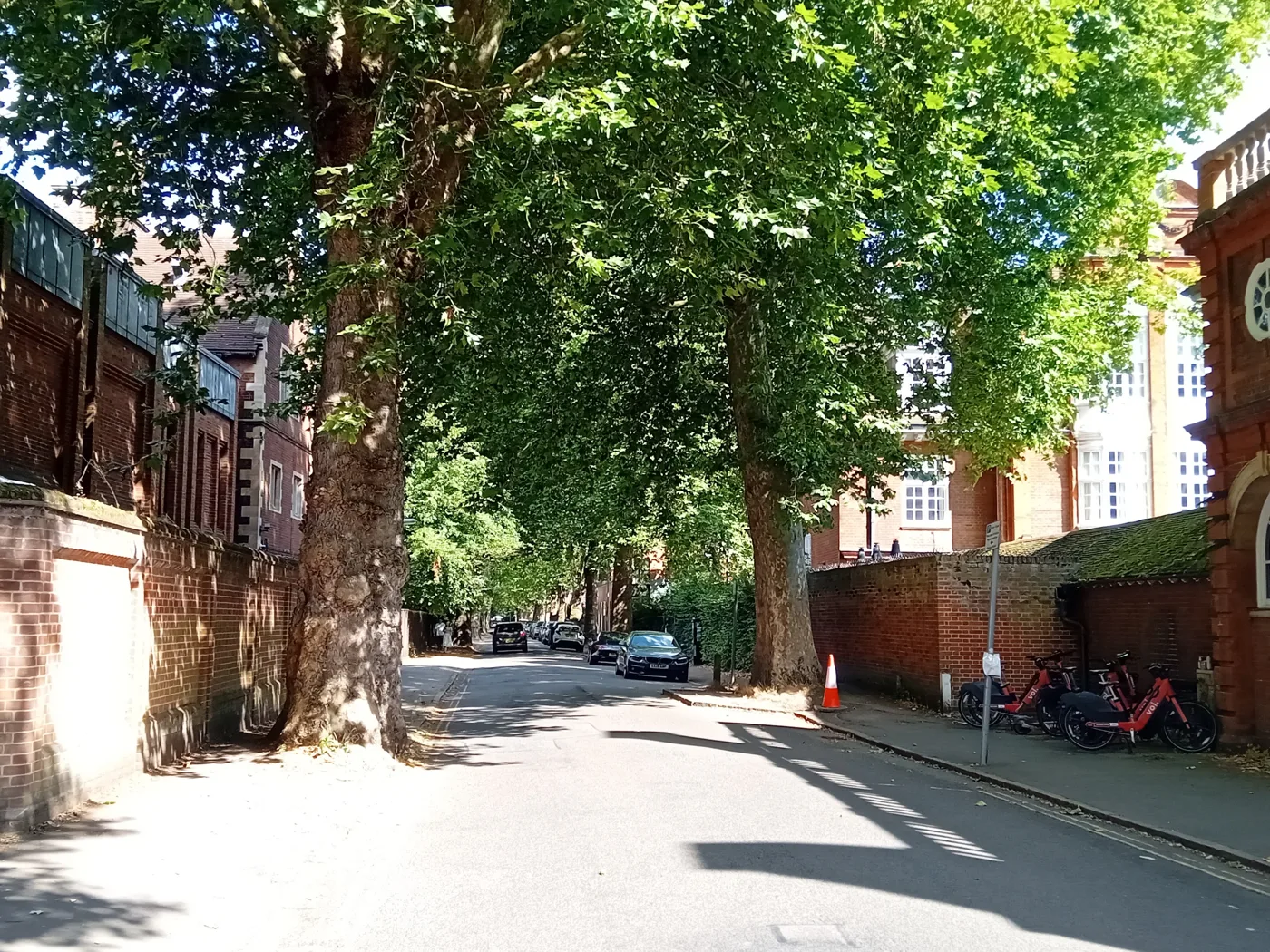
The pavement has been broken up by the roots of the street’s London plane trees. In places, the report says, it has become impassable for wheelchairs and pushchairs.
The GCP recorded how people moved along the street in March 2025, using anonymised visual data. On one short stretch, an average of more than 250 pedestrians and wheelchair users a day were using the road instead of the pavement. Its sensors at each end of the street found that over 70% of people using it walk or wheel.
The trees stay. “We have no intention of removing them,” Thomas Fitzpatrick, the GCP’s head of programme, said when the plan was published in February.
Brian Milnes, who chairs the GCP, said the trial was “designed to make the avenue safer and more accessible for everyone while protecting the character of the street and the much-loved London Plane trees that line it.”
The second attempt
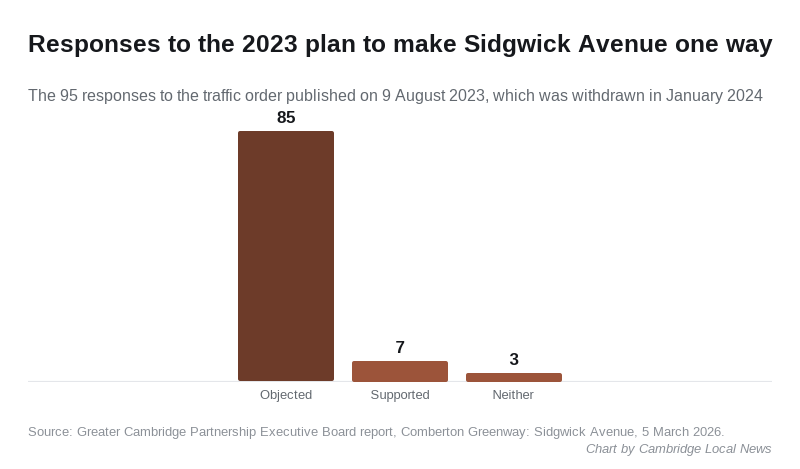
This is the GCP’s second plan for the street. In August 2023 it published an order to make Sidgwick Avenue one way for cars, with a cycle lane against the flow.
That drew 95 responses, and 85 of them were objections. People worried about longer car journeys, ambulance access to the Newnham surgery and the narrow cycle lane. Several said the plan did nothing for pedestrians. The Executive Board withdrew it in January 2024.
The new design came out of talks with Selwyn, Newnham and Darwin colleges, the University of Cambridge, the Residents’ Association of Old Newnham and Newnham Walk Surgery, among others. The GCP’s Joint Assembly backed it with one member dissenting, and the Executive Board approved it unanimously, according to the minutes.
The minutes also record concern that more consultation had not been done on the revised plan. At the Joint Assembly, members asked for the effect on West Road and other nearby streets to be monitored.
What it means for you
If you drive. While the works go on, the Queens Road and Silver Street junction is closed during working hours, Monday to Friday. The signed diversion runs along Newnham Road, Barton Road and Grange Road. Once the bollards are in, a driver going from the western end of the avenue to Silver Street goes round by West Road. The report puts the extra distance at about 480 metres, or 54 seconds at 20mph.
If you walk or cycle. Access stays open throughout the works, the GCP says.
If you want a say. The trial is an Experimental Traffic Regulation Order. Under that process, formal objections must be made within six months of the order coming into force, the report says, and the GCP will take feedback for the whole trial. The GCP’s pages did not give the date the order takes effect when we checked on 26 October. Its contact details are hello@greatercambridge.org.uk and 01223 699906.
After 12 months, officers will report back with a recommendation: make the changes permanent, or remove them. A decision has to be made within 18 months of the order coming into force. If the trial is kept, a second phase could bring full resurfacing, more greenery and better conditions for the tree roots.
Sidgwick Avenue is the last stretch of the Comberton Greenway before the city centre. Other closures this week are on our Cambridge roadworks page, and car parks and Park and Ride are covered in parking in Cambridge.
Sources
- Greater Cambridge Partnership, Construction starts on Sidgwick Avenue trial to improve accessibility, 19 October 2026
- Greater Cambridge Partnership, Sidgwick Avenue project page and ETRO plan, checked 26 October 2026
- Greater Cambridge Partnership, Proposals to make Sidgwick Avenue more accessible for all, 2 February 2026
- GCP Executive Board, 5 March 2026: agenda item 8 report, Comberton Greenway: Sidgwick Avenue, and the minutes
Have your say