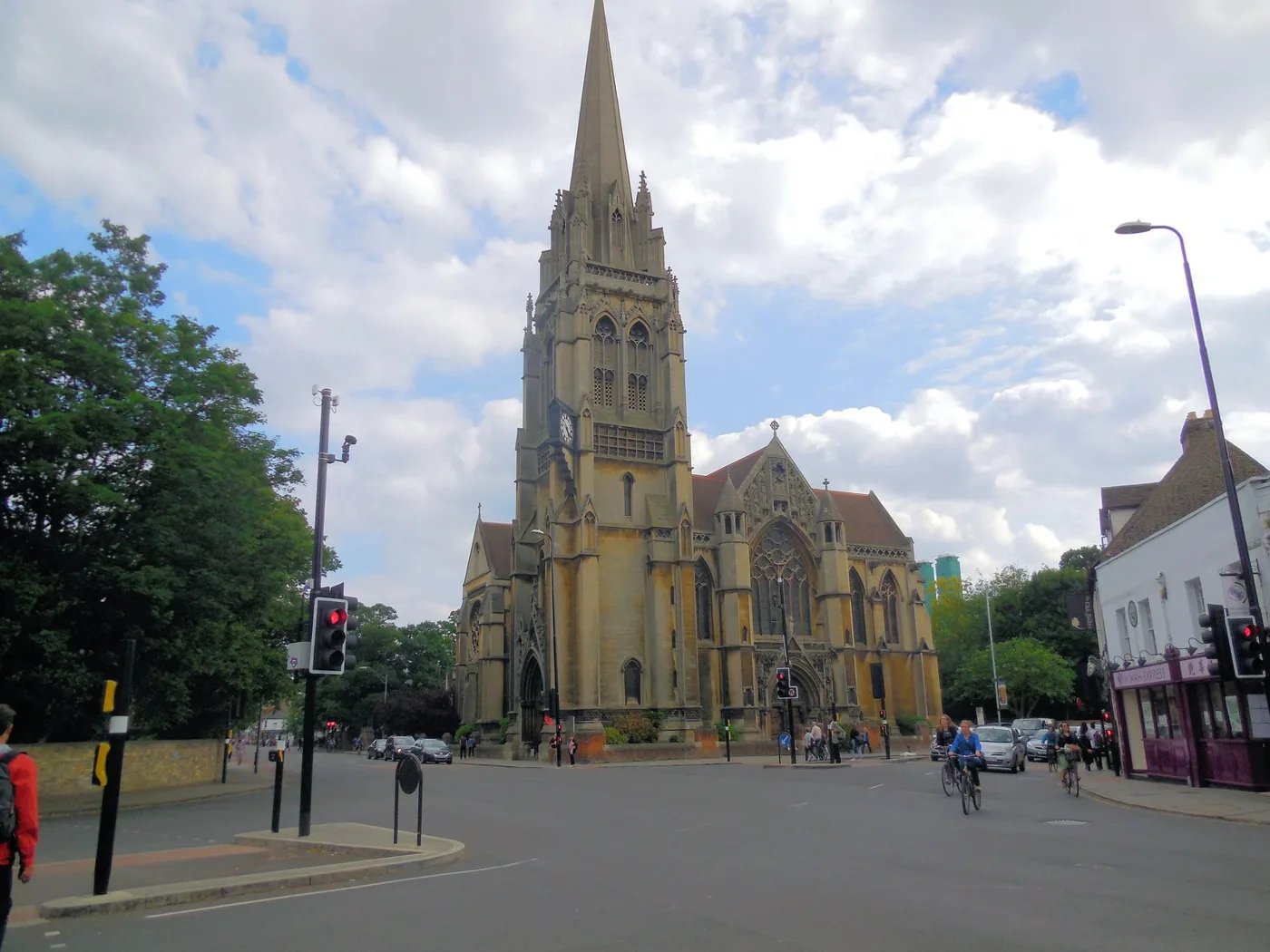

Historic England put Our Lady and the English Martyrs on its 2026 at-risk list at the highest priority. The parish needs £226,361 for the next repairs.
The Catholic church at the top of Hills Road is now on Historic England’s national Heritage at Risk Register. Our Lady and the English Martyrs, the Grade I listed church whose spire is the tallest structure in Cambridge, was added when the 2026 register was published on Thursday 5 November.
Historic England has put it in priority category A, the most urgent of the register’s six. Its entry describes that as “immediate risk of further rapid deterioration or loss of fabric; no solution agreed”.
Neither the parish nor the diocese says the church is closing. The problem is high up, in the carved stonework on its towers and walls.
What Historic England’s entry says
The register entry assesses the building like this:
| Measure | Historic England’s assessment |
|---|---|
| Condition | Fair |
| Vulnerability | High |
| Trend | Declining |
| Priority | A, immediate risk of further rapid deterioration or loss of fabric, no solution agreed |
| Owner | Religious organisation |
It is the only new Cambridge entry this year. We compared Historic England’s published register data for 2026 and 2025. Two other city entries carry over from last year:
- Stourbridge Chapel on Newmarket Road
- the Old Cheddar’s Lane pumping station, a scheduled monument
Why it was added
The parish published its own statement on the listing the same day. It says the decision followed investigations that found long-term deterioration of the stonework and carvings.
In 2023 a rope access team inspected the spire. They found damaged and dangerous stonework that they judged a “threat to life”. Emergency works removed about one tonne of loose stone, according to the parish.
A £1 million repair project on the spire and the south aisle followed in 2025 and 2026. The scaffolding and netting that covered the tower for more than six months last year were part of it, according to the diocese. The parish says “further investigations have shown that substantial work remains”.
Matthew Champion, the Diocese of East Anglia’s heritage officer, said the carvings and gargoyles had been exposed to the weather in a busy city for well over a century.
“Much of the upper-level stonework is now in poor condition, and in danger of failure, so we now need to fully understand the issues the church faces before putting in place a long-term plan to remedy them,” he said. “Being put on the Heritage at Risk Register is an opportunity to concentrate and prioritise on what needs to be done to ensure the building’s future.”
The parish welcomes it
The church’s rector and parish priest, the Rt Rev Mgr Canon Eugene Harkness, said the parish was “most grateful” for the recognition.
“Over the past two years we have worked hard to raise funds to complete repair work and cleaning of the spire and North Porch and the south roof,” he said. He hoped the listing would bring the rest of the work “to public notice and financial assistance”.
He added that “many of our fellow citizens have commented on the beauty of ‘The Catholic’ as it is called in common parlance”.
What still needs doing
The parish’s EndsUp Building Appeal sets out the next round of work. It says iron fixings set into the stone by the Victorian builders are corroding. As they rust they expand, cracking the stone around them and in some cases splitting pieces off.
The areas it names are:
- the central tower
- the east and west apses
- the Lensfield Road elevation above the main west entrance
Some pinnacle stones from the central tower have already fallen or been taken down for safety, the appeal page says. They are stored on the roof.
The work is planned in two phases. Phase one is the Lensfield Road elevation, with an estimated cost of £226,361.21 including scaffolding. The appeal page lists what the work covers:
- scaffolding around the central tower, the apses and the Lensfield Road frontage
- cleaning and conserving the stone with traditional lime-based methods
- replacing missing or damaged carvings, and repairing pinnacles and gargoyles
- removing or treating the corroded ironwork
- supports for the taller statues, and work on the windows, gutters and lightning protection
The parish has not published a cost for phase two.
A landmark built by one woman
The church was designed by Dunn, Hansom and Dunn of Newcastle and built between 1887 and 1890. It was paid for by one benefactor, Yolande Lyne-Stephens, who spent nearly £70,000 of her own fortune on it, according to the diocese.
The diocese describes it as the second largest Roman Catholic church in East Anglia. Its tower and spire rise 214ft, or 65 metres.
What it means for you
- Nothing changes for worshippers or visitors. The parish describes the church as a working centre of worship and community life, and nothing in either statement says it is closing.
- Expect scaffolding again. Phase one puts scaffolding around the central tower and the Lensfield Road frontage. The parish has not given a start date.
- Being on the register can help with money. Historic England uses it to direct attention and funding, and the parish says it hopes the listing brings financial help.
- You can give directly. One-off and regular gifts go to the EndsUp Building Fund through the appeal page. The parish is registered charity no. 278742.
The church is at the junction of Hills Road and Lensfield Road. Roadworks and closures near it are on our Cambridge roadworks page, and other building schemes in the city are on Cambridge planning news.
Sources
- Historic England, Heritage at Risk register entry 10219, read 9 November 2026, for the condition, vulnerability, trend, priority and ownership.
- Historic England’s Heritage at Risk register data for 2026 and 2025, for which Cambridge entries are new and which carry over.
- Our Lady and the English Martyrs parish, Cambridge Catholic landmark added to Heritage at Risk Register, 5 November 2026, for the 2023 inspection, the tonne of stone, the £1 million project and both quotes.
- Our Lady and the English Martyrs parish, EndsUp Building Appeal, read 9 November 2026, for the remaining work, the corroding ironwork, the fallen pinnacle stones and the £226,361.21 phase one estimate.
- Diocese of East Anglia, Restoration of OLEM nears completion, 6 November 2025, for the church’s history, height and benefactor.
Have your say