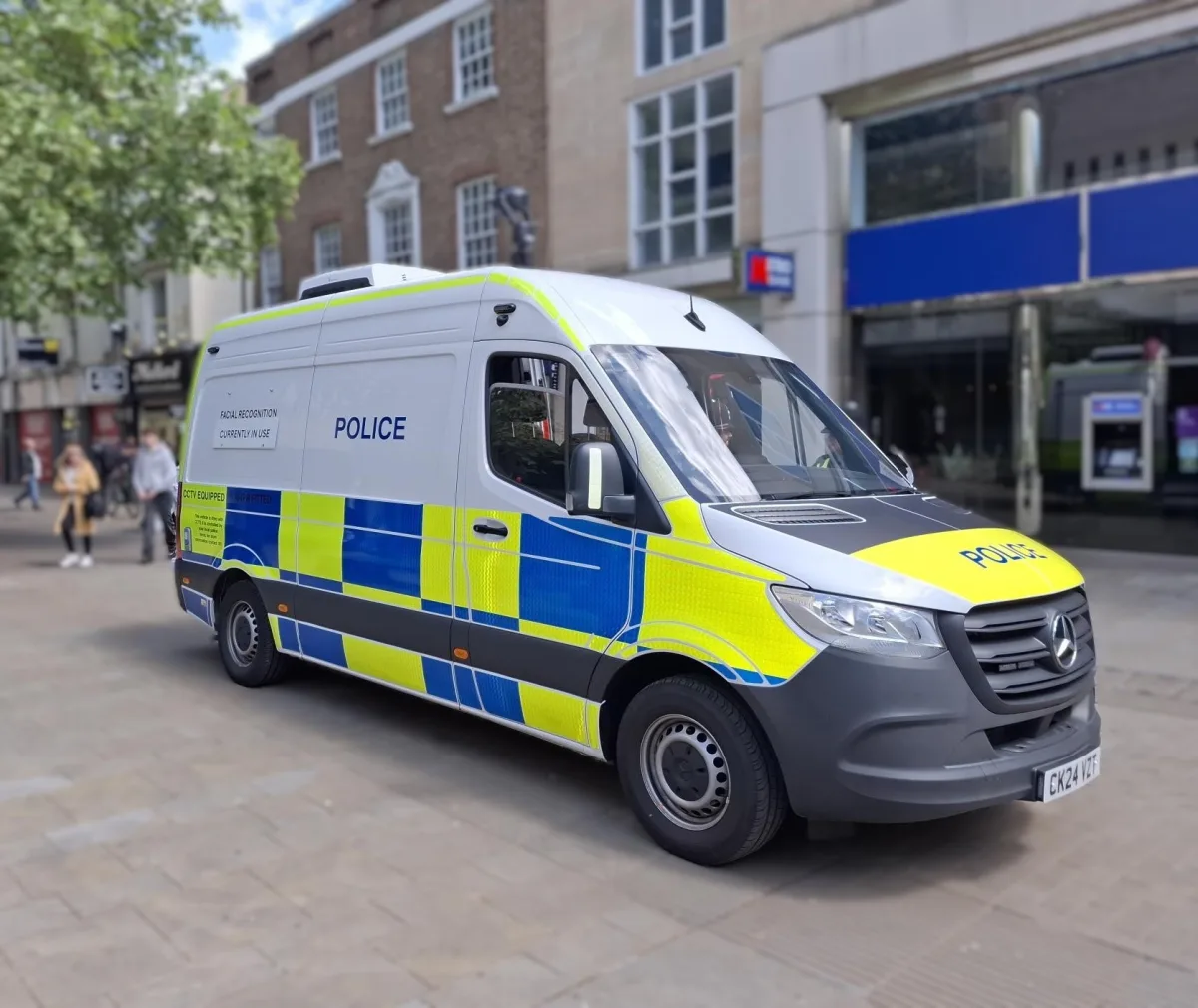

Police scanned 29,361 faces in Market Square and Sidney Street on 2 October. Four matches against a 917-person watchlist led to three arrests.
Cambridgeshire Police used live facial recognition cameras in Cambridge city centre on Friday 2 October, the first time the technology has been used in the city.
Updated 9 October: the force has published the results of the deployment. They are in the section below; the rest of this story was written on the day.
The results
The force’s results statement says the cameras ran from 10am to 4pm in Market Square and Sidney Street. The force had not named the streets or the hours beforehand.
The figures it gives:
- 29,361 faces scanned
- 917 people on the watchlist
- 4 positive matches
- 3 arrests
Two of those arrested, men aged 63 and 39, were wanted for failing to appear. A 52-year-old man was arrested in connection with theft and has since been charged with theft of a pedal cycle and theft by finding, the force says.
That is about one match for every 7,300 faces scanned. Inspector Sam Tucker, who oversaw the deployment, called it “an encouraging first deployment for Cambridge”. The force repeats that images of people who do not trigger an alert are deleted automatically, and that the watchlist is removed within 24 hours.
The force has not said whether or when the cameras will return to Cambridge.
What we reported on the day
The force announced the deployment on Thursday morning. It follows what it called “a series of successful deployments in Peterborough”. The force has not said which streets the cameras will cover or for how many hours. Its statement says only “the city centre”.
How it works
The cameras film people walking past and compare each face, in real time, with a watchlist drawn up by the police. The system turns key facial features into what the force calls a “facial biometric template”, a mathematical description of the face, and looks for a match.
The force says the watchlist holds three groups of people:
- people wanted for criminal offences
- people with outstanding warrants
- high-risk offenders who are under notification requirements set by a court
A match does not lead straight to an arrest. An officer looks at every image the system flags and decides whether anything more needs to happen.
What happens to your image
If you are not on the watchlist, the force says your image and biometric data are deleted automatically. Images that do trigger an alert are deleted immediately after use, or within 24 hours. The force says that once deleted, they cannot be retrieved.
Sergeant Luke Charlton said officers will be at the deployment all day to answer questions.
“We understand people may have questions about how the technology works, which is why officers will be on hand throughout the deployment to speak with members of the public and provide information. Transparency is really important to us, and we want people to understand the safeguards that are in place.”
He described the cameras as “another valuable tool” for finding “people who are sought by the courts or wanted in connection with offences”.
All of this comes from the force’s announcement of 1 October. The force also keeps a page on how it uses live facial recognition. That page blocked automated access when we tried to read it today, so nothing in this story is taken from it.
The city centre in numbers
Today’s deployment is about finding people who are already wanted. It is not aimed at any one type of crime, but the latest police figures show how busy the area is.
Police recorded 758 crimes and anti-social behaviour reports within a mile of Market Hill in August 2026, the most recent month published on police.uk. The most common were:
- violence and sexual offences, 195
- anti-social behaviour, 143
- shoplifting, 115
- bicycle theft, 56
Police.uk places each report at the nearest of a set of map points, not at the exact spot where it happened.
What it means for you
- You do not have to do anything. If you walk past the cameras and are not on the watchlist, the force says your image is deleted automatically.
- Look for the van and the officers. In the photograph the force issued, its van carries a sign reading “Facial recognition currently in use”. Officers will be there to explain how it works.
- You can ask questions on the day. The force says that is what its officers are there for. You can also contact Cambridgeshire Police through its website.
We will report the force’s results from today’s deployment when it publishes them.
Have your say