
Jason Beer KC will chair Part Two of the review after Professor Jason Arday's death, covering his appointment and time at Cambridge. It is due in six months.
The University of Cambridge has appointed barrister Jason Beer KC to chair the second part of its independent review following the death of Professor Jason Arday in August.
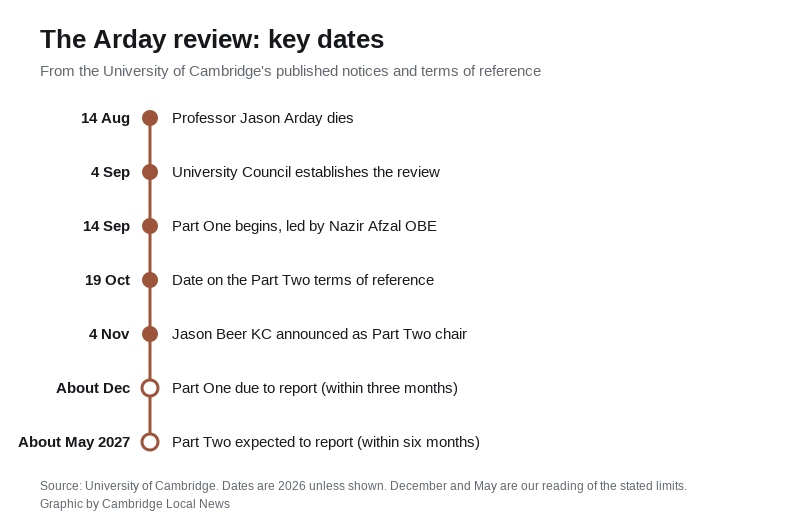
The University announced the appointment on 4 November. It also published the terms of reference for this stage of the review. They are dated 19 October and were agreed by the University Council.
Professor Arday, Professor of the Sociology of Education, died on 14 August, according to the terms of reference. He also held a fellowship at Jesus College. The terms say the college is legally separate from the University, but has been invited to co-operate and has agreed to take part.
Mr Beer was counsel to the Post Office Horizon IT Inquiry, according to his chambers.
What Part Two will examine
The University says Part Two will look at:
- the recruitment and appointment of Professor Arday, and of professors generally through the Board of Electors process
- induction, mentoring and support for him and for other professors
- the University’s response to allegations of research and other misconduct, in his case and more generally
- the support and protection available to academics facing significant public and media scrutiny
- arrangements on race equality, including the experiences of Black academics, and on disability, neurodiversity and reasonable adjustments
The terms go into some detail on each. On appointments, the review will look at how candidates’ records and credentials are verified and what due diligence is done on preferred candidates. On media scrutiny, it will look at when the University makes public statements about a member of staff and how those statements are approved.
In a statement published by the University, Mr Beer said the review would “examine some difficult and potentially uncomfortable questions”.
He added: “An independent review must be prepared to identify failings where the evidence supports them, but it must equally be prepared to say where arrangements and decisions were appropriate.”
What it will not decide
The terms of reference state: “Part Two is not an investigation of Professor Arday himself.”
The review will not:
- decide whether allegations about his research, qualifications, academic record, honorary appointments or personal history are proven
- assess the scholarly merit or integrity of his published work
- determine the cause of his death or anticipate the inquest
- determine legal liability or decide misconduct allegations against individuals
- adjudicate the conduct of journalists, publications, academics or other commentators
Those commentators’ activities may still be relevant to understanding the University’s decisions and its response to public scrutiny, the terms say.
In a statement on 5 August, before Professor Arday’s death, the University said it had begun an investigation following new information about his academic qualifications and honorary appointments. It also said complaints about academic misconduct were being handled under its Misconduct in Research policy.
Who is on the panel
Four people will support Mr Beer, the University said:
- Professor Rachael Gooberman-Hill, Professor of Health and Anthropology at the University of Bristol and Co-Chair of the UK Committee on Research Integrity
- Professor Rachel Brooks, Professor of Higher Education at the University of Oxford and a former President of the British Sociological Association
- Professor Bertha Ochieng, Professor of Integrated Health and Social Care at De Montfort University and Chair of the Black Leaders in Higher Education Network Steering Group
- Margaret Ayers, who has held senior roles at five universities and was until recently Chair of Universities Human Resources
The findings and recommendations remain Mr Beer’s. The terms say neither the Council, the General Board, the Vice-Chancellor nor any other University officer may direct him or the panel on how the review is run or what it concludes.
When it will report
Part Two is expected to report within six months of the terms being published, which points to about May 2027. Mr Beer can raise the timetable with the Council if he thinks it affects the review’s ability to be thorough and fair.
His report goes to the Council and the General Board. A summary of the findings and recommendations, along with the University’s response, will be published, subject to law, privacy, privilege and the welfare of living people. The Council is “encouraged” to publish the report in full, or as close to full as the law permits.
Part One is a separate piece of work led by Nazir Afzal OBE, the former Chief Crown Prosecutor for North West England. It looks at the support and protections available to Professor Arday before his death. The University set up the review on 4 September and Part One began on 14 September. The University said in September that it would report within three months, which points to December.
What it means for you
The review is asking people with relevant knowledge or experience to come forward. Anyone can send evidence or information about Part Two to ArdayReviewPartTwo@dacbeachcroft.com, which goes directly to Mr Beer and his team. They are supported by a junior barrister and solicitors at DAC Beachcroft.
If you work at the University, the terms of reference set out these protections and limits:
- The University has confirmed no member of staff will be disadvantaged for giving frank evidence.
- Evidence given in confidence will not be passed to the University for employment purposes.
- The review cannot guarantee that information will never have to be disclosed to a court, the Coroner or another body with lawful powers.
- Participants will be told how their information will be handled, kept and potentially disclosed before they give evidence.
Have your say