
Addenbrooke's brain injury team won a national NIHR Impact Prize for work that cut deaths by 20%. Royal Papworth and a transplant team were highly commended.
A Cambridge team whose research changed how traumatic brain injury is treated has won one of this year’s NIHR Impact Prizes. Two more Cambridge teams were highly commended.
The National Institute for Health and Care Research gives the prizes for research that has already changed health and care, not research that might. The 2026 awards were presented at a ceremony on 24 September, hosted by the institute’s chief executive, Professor Lucy Chappell. The NIHR published the full list of winners the same day.
The NIHR Biomedical Research Centre: Cambridge, which is hosted by Cambridge University Hospitals, set out the Cambridge results on 8 October.
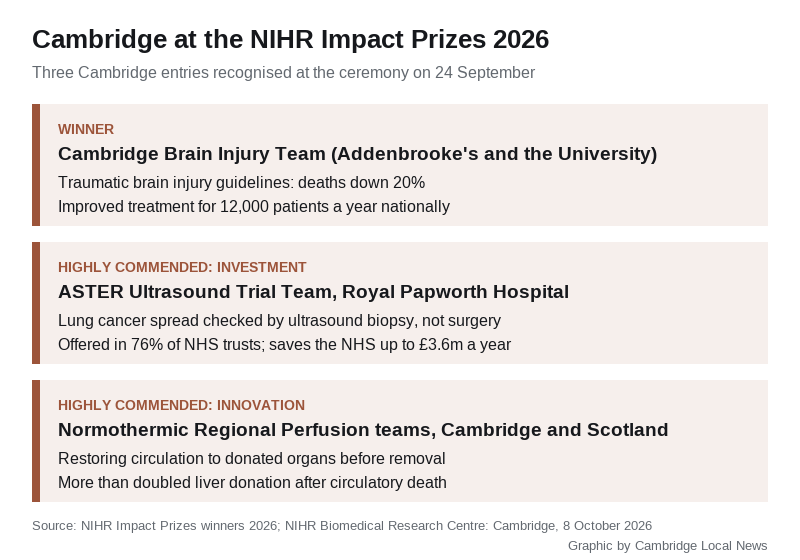
The winner: brain injury care
The prize went to the traumatic brain injury team at Cambridge University Hospitals, which runs Addenbrooke’s, and the University of Cambridge. It was one of seven research teams to win.
The NIHR says traumatic brain injury is a leading cause of death in high-income countries. The team’s research changed treatment guidance in the UK and abroad. According to the citation:
- surgical procedures and treatments developed by the team cut deaths by 20%
- two thirds of survivors went on to live independently, in the community or at home
- the new guidelines have improved treatment for 12,000 patients a year in the UK
- they have also reduced costs and pressure on health services
The work was funded through two NIHR programmes, Efficacy and Mechanism Evaluation and Health Technology Assessment. The Cambridge Biomedical Research Centre supported it, along with other NIHR brain injury and research delivery networks.
Highly commended: Royal Papworth’s lung cancer test
The ASTER trial team at Royal Papworth Hospital was highly commended, with recognition for investment.
Lung cancer kills more than 35,000 people in the UK each year, the NIHR says. Doctors need to know whether it has spread to the lymph nodes before deciding on treatment. That used to mean an operation.
The team tested a biopsy guided by ultrasound instead, passed through the airway and the gullet. The citation says it was more accurate than surgery, easier on patients and cheaper. The results so far:
- NICE guidelines now recommend the procedure
- 76% of NHS hospital trusts in England and Wales offer the test on site
- it saves the NHS up to £3.6 million a year
Highly commended: more donor livers
Normothermic Regional Perfusion teams at the University of Cambridge and the Scottish Liver Transplant Unit were highly commended, with recognition for innovation.
The NIHR says 120 people die on the UK liver waiting list each year because there are not enough usable organs. Many livers from donors after circulatory death go unused, because of doubts about how well they will work.
The teams adapted a way of restoring blood circulation to those organs after death and before removal. That lets surgeons check a liver is viable before it is transplanted. The research showed the technique more than doubled the rate of liver donation after circulatory death. Recipients also recovered from surgery more quickly.
The health departments of all four UK nations now fund it as a national service, according to the citation.
Second year running
It is the second time the prizes have been awarded. At the first ceremony, in March 2025, Cambridge researchers won two awards. One went to the capsule sponge team behind the “pill on a string” test for early oesophageal cancer. The other went to Dr Nurulamin Noor of the PROFILE trial on Crohn’s disease.
What it means for you
Patients in Cambridge are treated by the teams behind this work. If you or someone you know is admitted to Addenbrooke’s with a head injury, the care follows guidelines this team helped write. A patient at Royal Papworth being checked for lung cancer spread is likely to have the ultrasound biopsy rather than an operation.
Cambridge University Hospitals and the Biomedical Research Centre regularly look for volunteers for studies. The centre’s patients and public pages explain how to take part.
More health news from the campus: work has started on the new Maggie’s centre at Addenbrooke’s.
Have your say