
Cambridge Heartwear's £184m NHS tender is a place on two lots of a framework the NHS values at about £92m in all, shared with up to 15 other suppliers.
Cambridge Heartwear, the Milton Road company behind a chest-worn heart monitor called HeartSense, has won a place on an NHS buying framework for heart and lung diagnostic equipment. The company announced it on 7 October as a “£184 million NHS tender”.
The official award notice tells a more modest story. It is a shared framework, not a contract for £184m. NHS Supply Chain puts the whole framework at about £92m including VAT over up to four years. Cambridge Heartwear is one of 26 suppliers on it.
What the company announced
The company’s press release, distributed by PR Newswire, says HeartSense is the first medical-grade, multi-channel, wirelessly charged ECG wearable that sends its readings straight to a mobile phone. It makes these claims for the device:
- it was engineered in Cambridge and is manufactured in Britain
- it holds 86 patents
- it is UKCA approved and ISO certified
- applications for US approval, through the FDA’s 510(k) route, are in progress
Professor Rameen Shakur, the company’s founder, said in the release: “We did not have a UK ECG manufacturer and reporter until now.”
The device has been in development for years. The University of Cambridge reported on HeartSense in September 2018, when the start-up was led by Dr Shakur and Professor Roberto Cipolla of the Department of Engineering. The university said then that the monitor used AI to flag irregular and dangerous heart rhythms.
What the award notice actually says
The deal is set out in a contract award notice on the government’s Find a Tender service, reference 2026/S 000-061999. It was published on 2 July 2026 by Supply Chain Coordination Limited, the company that trades as NHS Supply Chain.
The key points from the notice:
- It is a framework agreement. Only NHS Supply Chain can order from it. It then sells the equipment on to NHS trusts, other NHS bodies, government departments and private healthcare providers.
- The total estimate is about £92m including VAT (£76.7m before VAT) across the full term.
- First-year spending is expected to be around £17.3m, which the notice calls approximate.
- It runs from 27 July 2026 to 26 July 2028, with an option to extend to 26 July 2030.
- Cambridge Heartwear won places on two of the three lots. Lot 1 covers ECG devices and management systems. Lot 2 covers ambulatory monitoring, wearable recorders and related services.
The notice lists £92m against each lot. Two lots at £92m add up to £184m, which matches the company’s headline figure. But the notice says next to each value that “framework lot values may be shared with other lots”, and it describes £92m as the estimated value of the whole framework.
How many rivals share the same lots
A place on a framework does not guarantee any orders. It means a supplier has passed the assessment, so NHS buyers can purchase from it without running their own full tender.
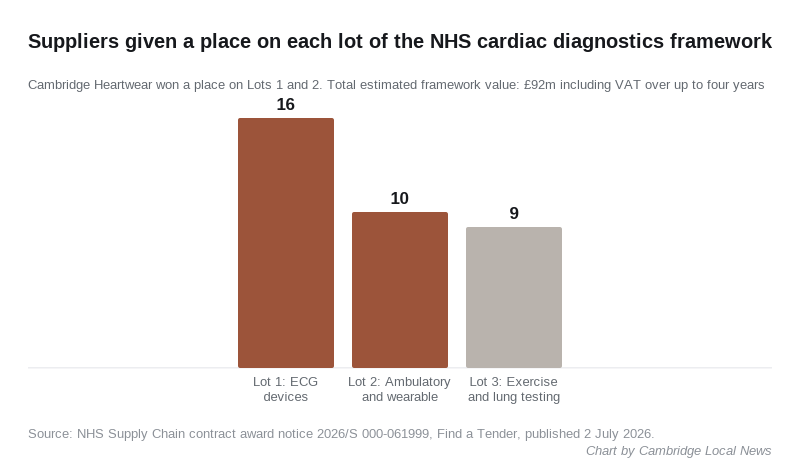
According to the notice:
| Lot | Tenders received | Suppliers awarded a place |
|---|---|---|
| Lot 1: ECG devices and management systems | 22 | 16 |
| Lot 2: Ambulatory monitoring and wearable recorders | 15 | 10 |
| Lot 3: Exercise and lung function testing | 11 | 9 |
Cambridge Heartwear sits on Lot 1 alongside large manufacturers including GE HealthCare, Philips and Mindray. On Lot 2 its rivals include iRhythm Technologies and LifeSignals. The notice classes Cambridge Heartwear as a small or medium-sized enterprise.
How much of the framework’s spending reaches the company will depend on what trusts and other buyers choose to order over the next two to four years.
What it means for you
If your GP or hospital sends you for heart rhythm monitoring, the device you are given is chosen by the trust or practice, not by you. This framework widens the list of approved monitors they can buy quickly, and a Cambridge-made one is now on it.
For Cambridge, it is a real step for a local medtech firm: it has passed NHS Supply Chain’s assessment against much bigger competitors. The size of the business that follows is not yet known, and the £184m figure should not be read as money the NHS has agreed to spend with one company.
Have your say