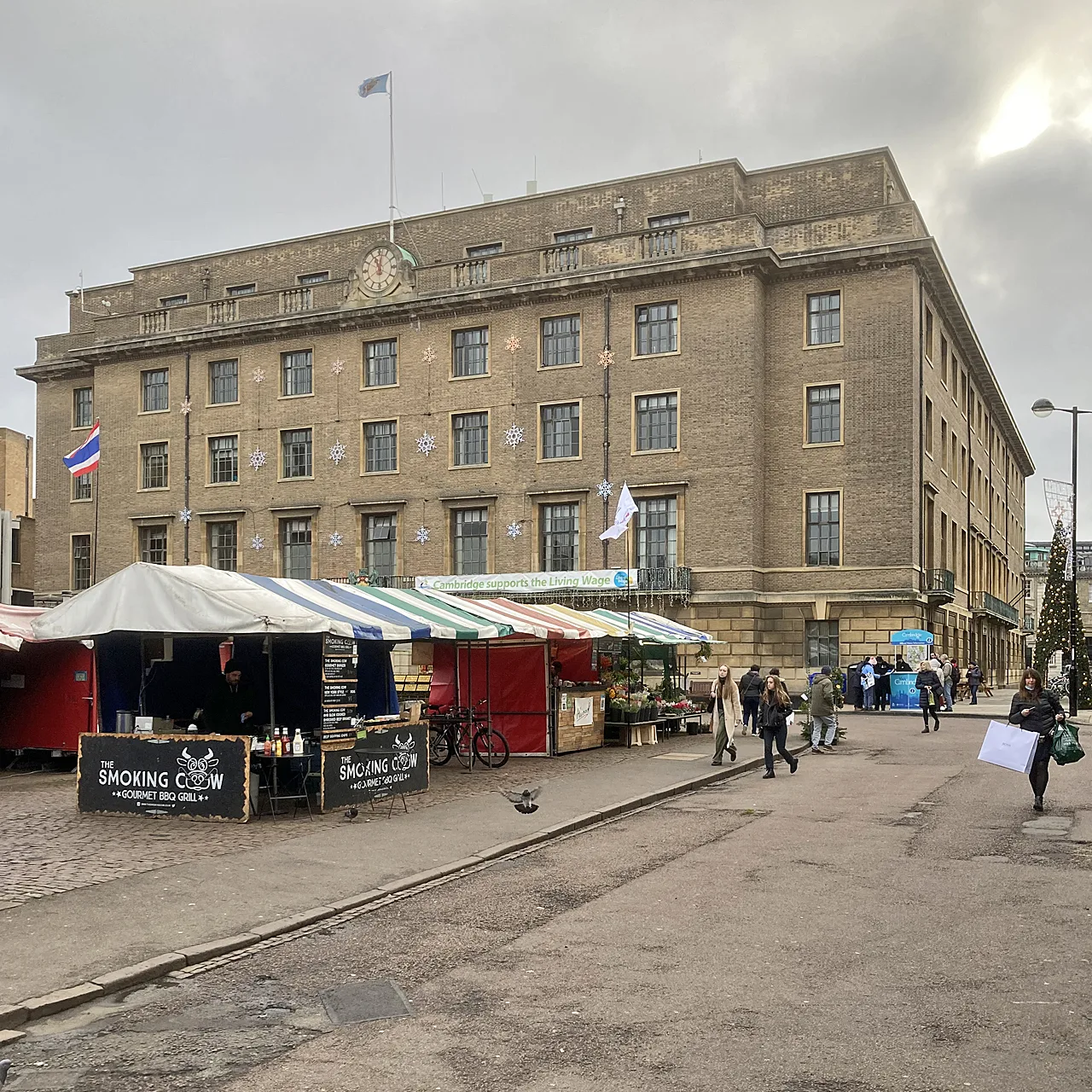

Cabinet chose option 1 on 16 November: refurbish the Guildhall and move staff in, not sell it. Full Council votes on the £86.88m on 26 November.
Updated 20 November: Cabinet unanimously chose option 1, the full scheme, on 16 November. Full Council votes on £86.88m of new spending on 26 November. Our story on the decision has the detail.
Selling the Cambridge Guildhall is one of four options going before councillors next week. The city council’s officers say a sale is the best option for its budget on their figures. They also say it would end “eight hundred years of civic use on the site”.
The options are set out in a project update report for the council’s Performance, Assets and Strategy scrutiny committee. It meets at 5.30pm on Tuesday 3 November at The Meadows Community Centre on Arbury Road. The committee is not asked to decide. Its views go to Cabinet on Monday 16 November, and the report gives 26 November as the date for the decision on whether to proceed.
All four options still refurbish the Market Square and the Corn Exchange. They differ only on the Guildhall.
Why the decision is back
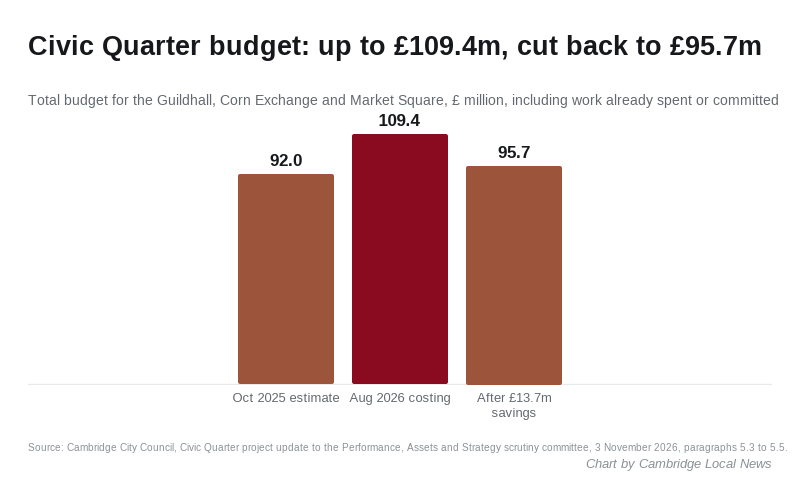
The Civic Quarter project covers the Guildhall, the Corn Exchange and the Market Square. In October 2025 the whole scheme was costed at £92m. A more detailed costing in August 2026 came to £109.4m, the report says, with £11.9m of that already spent or committed.
Officers have since cut £13.7m, bringing the budget to £95.7m. The main savings on the Guildhall are:
- dropping the EnerPhit insulation standard for ordinary Building Regulations compliance, saving £2.5m
- dropping the planned fourth-floor extension, saving £1.75m
- cheaper floor finishes, lighting and AV, saving £1.23m
- cheaper lifts and atrium work, saving about £1.46m between them
Borrowing has also become more expensive. The report says gilt rates are “at an almost 30-year high”, and the project would need up to £60m of new external borrowing.
The four options
The report models what each option would do to the council’s General Fund, the budget for day-to-day services, over 30 years at current prices.
| Option | What happens to the Guildhall | 30-year General Fund impact |
|---|---|---|
| 1. Full scheme | Refurbished; about 150 council staff move back in; Mandela House sold or let | £8.5m cost |
| 2. Refurbish and rent out | Refurbished; council keeps the chamber and halls, lets the rest; staff stay at Mandela House | £0.4m gain |
| 3. “Kick the can” | Left as it is; decision passed to a future unitary council | £5.5m gain |
| 4. Sell | Sold to the highest bidder, most likely as a hotel | £20.1m gain |
Those figures need reading with care. The report says the option 3 gain “should not be interpreted as a forecast outcome”. It leaves out the cost of eventually doing something with the Guildhall. Options 3 and 4 also assume the council stays in Mandela House on Regent Street, which the report says will need upgrading at some point between 2030 and 2035.
Option 1 would give the city a Guildhall open to the public, with a café, new toilets and an accessible chamber. The report says it is “not entirely self-financing” and relies on extra income from the Park Street hotel.
Option 2 restores the building to the same standard. The ground floor and café would probably be leased commercially, so the public would only get in for events.
Option 3 leaves the Guildhall “closed off and underused at the centre of an improved public realm”. Officers warn the chamber “will remain at risk and out of action” until a later decision. The current planning consent would expire, and a new application could cost more than £3m.
Option 4 is “the most financially attractive option” on the figures modelled. But a recent valuation found the sale value “would be low”, because the listed building has compliance problems. Officers also point out that the county council’s sale of its former county hall took eight years.
What state the building is in
The report lists the problems with the Guildhall in its current condition. They include:
- water damage from leaks
- leaking, corroded heating pipes
- the risk of “Regent’s Street disease”, where a corroding steel frame cracks the stonework
- masonry falling from the outside walls
- electrics, lift and fire alarm that are not compliant
- a damaged roof over the council chamber, which “already has a risk of ceiling collapse”
Only basic maintenance has been done for 30 years, the report says. Most of the building has not been used as council offices since March 2020.
What has already changed
The Guildhall closed to the public on 2 October, apart from event days. The Allia Future Business Centre moved out at the end of September. The Sticks ‘n’ Sushi and Giggling Squid restaurants stay open, as they are outside the works area.
The last event in the Large and Small Halls is on 20 December. Full Council and planning committee meetings have moved to Downing Place United Reformed Church. The last show at the Corn Exchange is on 31 December, after which it closes for about 18 months.
If the scheme goes ahead, the report’s timetable has building work starting in January 2027. The Market Square would finish in March 2028, the Corn Exchange in summer 2028 and the Guildhall in December 2028.
What it means for you
- The Market Square and Corn Exchange work goes ahead under every option. Our story on the Market Square approval sets out what is planned there.
- Whether the Guildhall reopens to the public depends on the choice. Only option 1 promises a public café and open ground floor. Under option 4 the public would get in only as paying customers of whoever buys it.
- You can watch the debate. The scrutiny meeting on 3 November is public, and the council says meetings will continue to be live-streamed as necessary. Agendas are on the council’s democracy site.
- The full set of appendices, including the condition survey and the financial modelling, is on the council’s Civic Quarter reports page.
Have your say